
State of Play 2025 – AfCFTA and Human Rights
The Raoul Wallenberg Institute of Human Rights and Humanitarian Law (RWI), in collaboration with the Konrad Adenauer Stiftung (KAS), has published a new report examining how human rights are being integrated into the implementation of the African Continental Free Trade Area (AfCFTA).
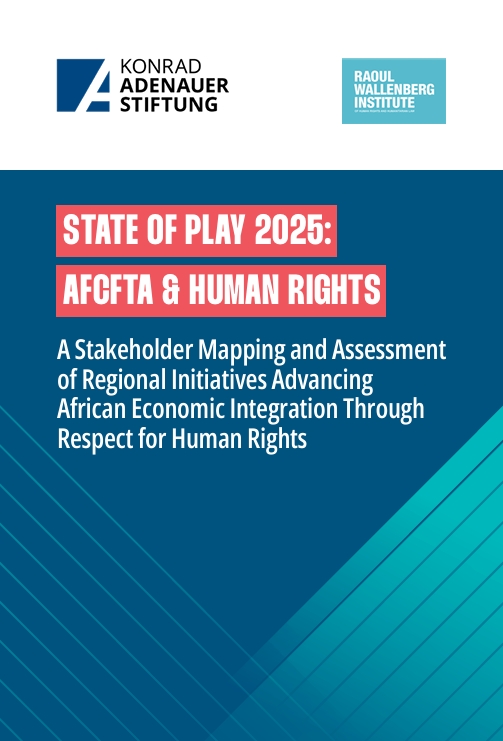
Titled “State of Play 2025: AfCFTA and Human Rights – A Stakeholder Mapping and Assessment of Regional Initiatives Advancing African Economic Integration Through Respect for Human Rights,” the study was officially launched in Addis Ababa in March 2026. It provides the first comprehensive, empirically grounded mapping of actions taken by continental, regional, and national stakeholders to advance the AfCFTA through a human rights-based lens.
A Rigorous, Consultative Research Process
The seed for this study was planted during a roundtable discussion in Addis Ababa in February 2025, on the margins of the 38th AU Summit, where RWI and KAS first explored the need for a systematic mapping of the interface between trade and human rights.
The research itself combines desk-based analysis with in-depth, semi-structured interviews conducted with 19 organisations across the continent, including the AfCFTA Secretariat, the African Commission on Human and Peoples’ Rights, the African Committee of Experts on the Rights and Welfare of the Child, Regional Economic Communities, AU Member State representatives, civil society networks, trade unions, business associations, and international partners.
The findings were then presented for critical feedback and validation at the 4th African Business and Human Rights Forum in Lusaka, Zambia, in October 2025. Following the forum, a draft report was circulated widely to all interviewees and a broader range of stakeholders for additional input and review, ensuring that the final publication reflects diverse perspectives and has been tested by those working at the intersection of trade and human rights.
About the Study
The report analyses the legal frameworks governing the AfCFTA – including the Protocols on Trade in Goods, Trade in Services, Digital Trade, Investment, Competition, Intellectual Property, and Women and Youth in Trade – and assesses their human rights implications. It then examines what key institutions are doing in practice.
Key Findings
The report finds that while there is promising activity across many institutions – particularly initiatives focused on women and youth – significant gaps remain. The most notable gap is the absence of formal collaboration between the AfCFTA Secretariat and the African human rights mechanisms. Both institutions appear to work in silos, with limited interaction between them.
On MSME empowerment, the report notes that programmes such as AUDA-NEPAD’s 100 million MSME initiative have already reached over 3 million people, offering key entry points for integrating human rights indicators into future phases of this work.
Regarding trade information, the African Trade Observatory (ATO) – a continental trade information platform – currently lacks explicit human rights content. However, its forthcoming phase on trade in services, scheduled for 2026, presents an opportunity to embed human rights and accessibility features for persons with disabilities.
The report also examines national AfCFTA implementation strategies, which have been developed by 50 countries. While these increasingly include women and youth, the report finds that human rights are not explicitly referenced, and groups such as persons with disabilities, children, and older persons remain largely excluded from the current frameworks.
A further barrier identified by the report is the slow progress on the African Free Movement Protocol, which has only four ratifications to date. This significantly hinders trade in services and labour mobility across the continent.
Recommendations and Entry Points
The report identifies four crucial entry points for stakeholder action. First, it recommends leveraging existing MSME empowerment programmes to integrate human rights indicators more systematically. Second, it calls for using the African Trade Observatory’s next phase as a platform for co-creation between trade and human rights institutions. Third, it urges stakeholders to strengthen national implementation strategies with explicit human rights commitments and broader inclusion of marginalised groups. Fourth, it proposes establishing formal memoranda of understanding, joint workshops, and dedicated desks within institutions to bridge the current divide between trade and human rights communities.
Read the full report here
Read more about RWI’s Regional Africa Programme here