By Halyna Kokhan, Programme Officer Ukraine Office
As part of its ongoing commitment to advancing clinical legal education globally, the Raoul Wallenberg Institute of Human Rights and Humanitarian Law facilitated online exchanges between the Association of Legal Clinics of Ukraine (ALCU) and representatives of legal clinics from Armenia and Zimbabwe in mid-March.
The meetings provided a platform for participants to share experiences on how legal clinics are structured and operate in their respective national contexts, the challenges encountered in day-to-day practice, and the approaches that have proven to be the most effective in delivering legal aid and education.
The ALCU presented its lessons learned in building and sustaining a national network of legal clinics in Ukraine, including the integration of educational and social functions, development of the operational standards, capacity-building tools, and the use of digital resources. The Association’s coordinating role within this network was highlighted as a key factor in its resilience, particularly in the current context of war.
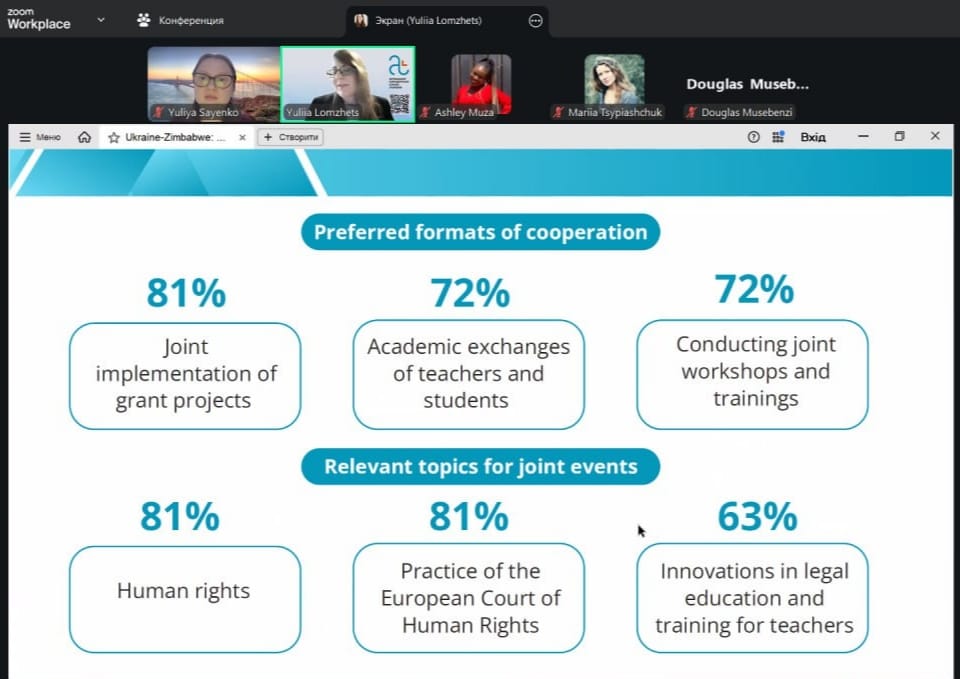
Discussions also looked ahead to concrete forms of collaboration, including joint projects, exchange programmes, and training activities for both faculty and students. Shared thematic priorities identified across all three countries included human rights, the jurisprudence of the European Court of Human Rights, and the broader development of clinical legal education.
These cross-regional dialogues reflect RWI’s conviction that sustainable progress in clinical legal education depends on strong networks, mutual learning, and meaningful partnerships across borders.
Read more about RWI’s work in Ukraine: Our work in Ukraine – The Raoul Wallenberg Institute of Human Rights and Humanitarian Law
This workshop was made possible with the generous support of the Swedish International Development Cooperation Agency (SIDA). RWI acknowledges their commitment to strengthening human rights capacity in the region.