
By: Charlie Meidino Albajili, Programme Officer for Access to Justice/Business and Human Rights, Jakarta Office
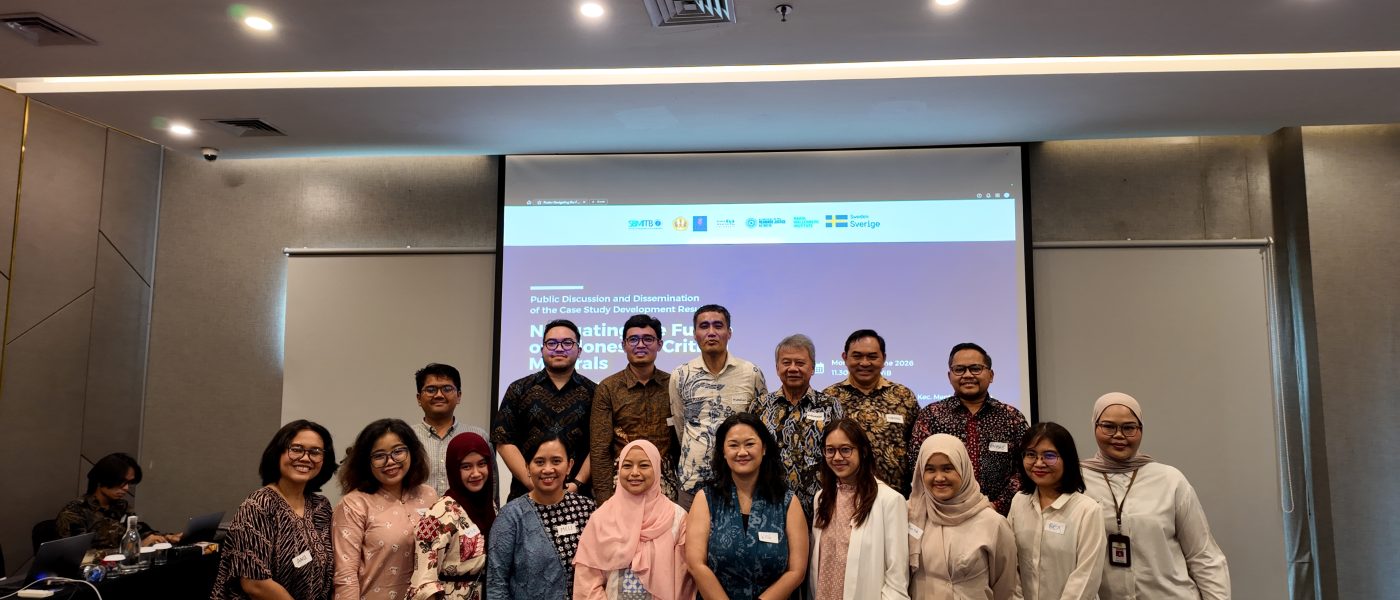
RWI Asia and the Pacific Office has published a teaching case on responsible business conduct in Indonesia’s nickel sector, co-developed with Pusat Studi Hak Asasi Manusia (PAHAM) at Universitas Padjadjaran, the School of Business and Management at Institut Teknologi Bandung, and Publish What You Pay Indonesia. It is written for law and business management classrooms and is openly available.
The case method
Responsible business conduct is ordinarily taught as a body of standards: the UN Guiding Principles, the OECD guidance, national regulation. That approach establishes what the standards require. It is less able to show what applying them costs.
The case method proceeds differently. It sets out a real business situation, supplies the evidence a decision-maker would realistically have, and stops at the point where a judgement has to be made. It is not a report and it reaches no conclusion. The difficulty it exposes is rarely ignorance of the standards. It lies in weighing them against price pressure, competitor conduct, community expectations, and evidence that has not yet arrived.
The subject
Indonesia produced more than 60 per cent of the world’s nickel in 2024. This is where the energy transition is physically being built, and where the human rights questions attached to it arise.
We use example of PT Vale Indonesia Tbk, the country’s longest-operating nickel producer. Its Sorowako operation runs on hydroelectric power, and the company holds a sustainability-linked loan and is undergoing a full audit against the Initiative for Responsible Mining Assurance (IRMA) standard. Its operations also include a pipeline network in a seismically active corridor, where leaks have been recorded since 2009. The most recent occurred near Lioka village in August 2025. The company carried out clean-up and compensated the affected communities. The cause has not been publicly determined.
The combination is what makes the case useful for teaching. It places the reader in the seat of a newly appointed chief executive holding two decisions at once. One is strategic: how to respond to a campaign to classify nickel as clean or dirty, which would group producers by country of origin rather than by operational profile. The other is operational: how to address a risk where remedy has been provided but prevention remains an open question. Two mini cases take each decision separately.
Sources and limitations
The case draws on public disclosure and on consultations conducted during its development. It does not draw on internal corporate documents or non-public operational data, so some questions a real decision-maker would answer from internal records remain open, including the cause of the 2025 incident. That is a limitation, and also part of the exercise. Participants decide on the evidence external stakeholders actually hold.
Development and use
The case was written jointly by legal academics, business school faculty and civil society practitioners, which is why it reads as neither a purely legal nor a purely managerial document. It was tested with lecturers and with students from a range of disciplines before publication, and revised on what the classroom showed. It has been taken into a human rights law course at Universitas Padjadjaran, and taught in postgraduate classes on ESG and business ethics at Institut Teknologi Bandung.
The full case supports a two-session sequence, or a single session of about 90 minutes. Either mini case supports a single short class or workshop. It suits postgraduate and advanced undergraduate teaching in law and in business management, mixed-discipline groups, and professional training with regulators, national human rights institutions, judiciaries and companies.
Read and use the case
Vale Indonesia and Responsible Business Conduct in the Critical Minerals Sector is available to read and download here.
The two mini cases are also available through the School of Business and Management, Institut Teknologi Bandung, and through PAHAM, Universitas Padjadjaran.
A separate teaching note sets out learning objectives, suggested answers, in-class activities and two session plans, one for law schools and one for business management schools. It is not published openly and is available to educators and facilitators on request.
To request the teaching note, enquire about adopting the materials, or discuss the case further:
- PAHAM, Universitas Padjadjaran: paham.fh@unpad.ac.id / chloryne.dewi@unpad.ac.id
- School of Business and Management, Institut Teknologi Bandung: lidia.mayangsari@sbm-itb.ac.id / ibcc@sbm-itb.ac.id
- Publish What You Pay Indonesia: meliana@pwypindonesia.org / sekretariat@pwypindonesia.org
- Raoul Wallenberg Institute: charlie.meidino_albajili@rwi.lu.se
This publication was produced under the RWI Regional Asia and the Pacific Programme with the support of the Swedish International Development Cooperation Agency (Sida). The views expressed are those of the contributors and do not necessarily reflect the views of RWI, Sida, or the partner institutions.
The case has been prepared solely as a basis for classroom discussion. It is not intended as an endorsement, as a source of primary data, as an illustration of effective or ineffective management, or as a legal assessment of the conduct of any company, public authority or individual named in it.