
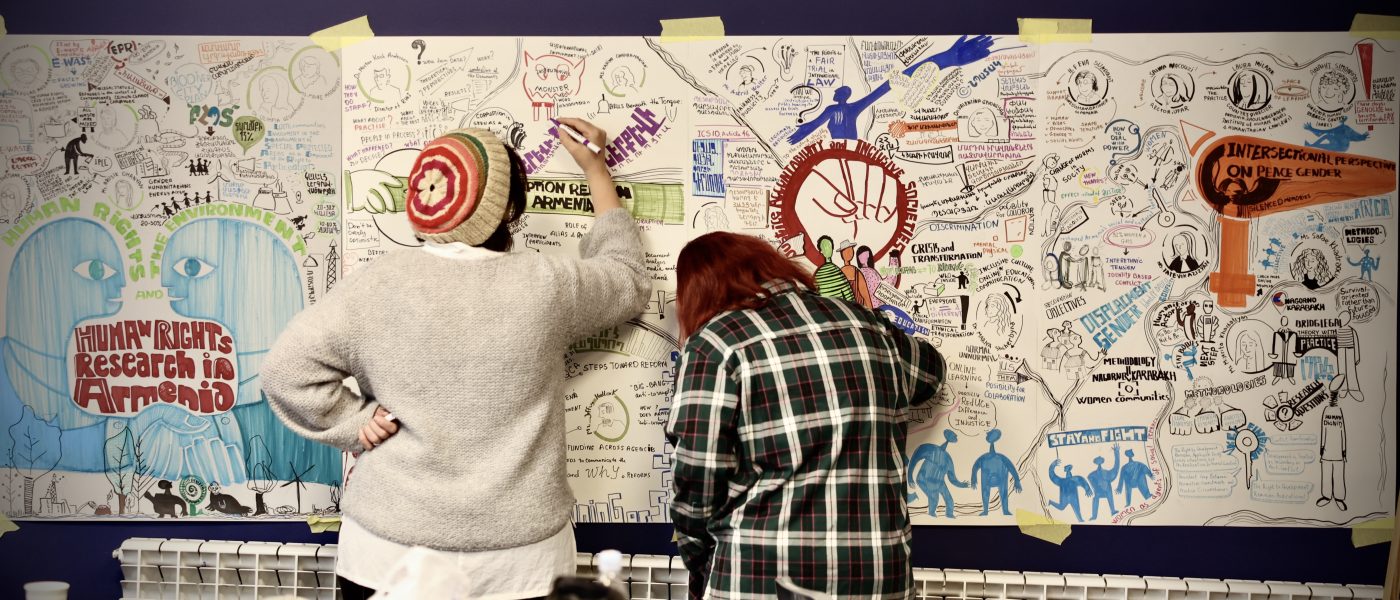
By Ani Ghulinyan, Communications Associate
Laura Milne’s appointment as Country Director of the Raoul Wallenberg Institute (RWI) in Armenia in March 2025 provided a timely opportunity to reflect on the progress to date, identify what has proven effective, and clarify priorities for the next phase of the Institute’s work.
Drawing on an in-depth interview with Milne, this article highlights four directions shaping RWI Armenia’s current approach:
- grounding human rights in lived experience;
- prioritising institutional ownership;
- strengthening research and evidence-based reform, and
- expanding interdisciplinary and innovative engagement.
Together, these priorities reflect a practical approach to human rights practice – one that connects international standards to the everyday realities of individuals, institutions, and communities across Armenia.

Bridging Human Rights Frameworks and Lived Realities
A recurring challenge in Armenia, as in many contexts affected by conflict and socio-economic pressure, is the distance between human rights discourse and daily lived experience. Periods of instability and displacement inevitably shape how individuals and communities prioritise immediate survival needs over rights-based language.
RWI seeks to bridge that gap. Instead of assuming that international human rights frameworks automatically resonate at the community level, RWI in Armenia is interested in understanding how people articulate their own concerns and experiences. This will demand a sustained presence outside Yerevan, long-term engagement with regional actors, and a willingness to adapt rights-based language to the issues communities themselves prioritise – reframing human rights through concrete issues such as access to services, environmental safety, public participation, and social inclusion.
Institutional Ownership and Sustainable Capacity Sharing
Another defining direction has been a deepening of our commitment to co-creation and institutional ownership. While RWI has long prioritised partnership-based approaches, the experience in Armenia, and Laura’s experience elsewhere, has reinforced that equitable collaboration – where national institutions shape priorities, methodologies, and outcomes – leads to more sustainable and meaningful change. This is reflected in RWI’s work with partners, including theHuman Rights Defender’s Office and the United Nations Development Programme, where joint design and shared responsibility strengthened both process and impact.
By embedding human rights mechanisms within existing structures, this process-oriented methodology prioritises long-term impact over short-term outputs. The aim is to support reforms that are resilient, accountable, and sustainable, reducing long-term dependence on external actors.
Research as a Foundation For Policy and Reform

Strengthening human rights research has emerged as a further strategic priority. Without such foundation, reforms risk being shaped by assumptions rather than realities. RWI continues to expand partnerships with universities, researchers, and academic institutions through international conferences, fellowship programmes, and targeted academic exchanges. A notable example is the study tour organised by RWI, with funding from the Swedish Government, which brought the chair of AUA’s LLM and Human Rights and Social Justice programmes, together with the Dean of the College of Humanities and Social Sciences, to Lund University. The visit enabled in-depth engagement with the university’s academic leadership, human rights scholars, and specialist librarians, creating space to explore concrete avenues for joint research, curriculum development, and long-term institutional cooperation.
This focus reflects the understanding that effective legislation and public policy must be informed by robust, locally grounded evidence. At the same time, RWI’s approach challenges the notion that expertise flows in only one direction. Armenia’s human rights professionals, scholars, and activists bring perspectives shaped by complex social and political experiences that are relevant well beyond the national context. RWI’s research initiatives, therefore, aim to foster genuine exchange, connecting Armenian researchers with global academic networks while amplifying Armenia’s experience as a source of learning for the international human rights community.
Innovation. Interdisciplinarity. New Audiences
Expanding human rights engagement beyond traditional legal and policy circles is increasingly reflected in its engagement in Armenia. Recognising that many of today’s most pressing societal challenges emerge at the intersection of multiple disciplines, RWI has sought to engage actors who do not typically operate within the human rights ecosystem. This approach reflects an understanding that sustaining the relevance of human rights requires dialogue with new professional communities and the integration of rights-based thinking into emerging fields of practice.
A recent collaboration with TUMO Labs illustrates this direction. Emerging from a shared interest in environmental and climate-related challenges, the partnership was shaped by the recognition that technological development increasingly intersects with questions of access, equity, participation, and environmental rights. By engaging a community primarily composed of engineers, coders, and product developers, RWI sought to introduce human rights not as an abstract legal framework, but as a practical lens through which technological solutions are conceived, designed, and evaluated. By emphasising learning, exposure, and collaboration across disciplines, the initiative aimed to foster longer-term capacity and awareness, highlighting how technical expertise can meaningfully contribute to public-interest challenges at both national and global levels.
Looking Towards The Future
As RWI advances in initiating and implementing beneficial and innovative projects in Armenia, these directions point to an approach that remains firmly anchored in international human rights standards while being deeply responsive to local realities. Emphasising co-creation, research, innovation, and interdisciplinarity reflects a broader effort to strengthen institutional trust at a time when confidence in human rights systems is under significant global pressure.
In this sense, RWI’s work in Armenia functions not only as national engagement but as a living laboratory for rethinking how human rights practice can remain meaningful in times of uncertainty and transformation.