
By: Charlie Meidino Albajili, Programme Officer for Access to Justice/Business and Human Rights, Jakarta Office
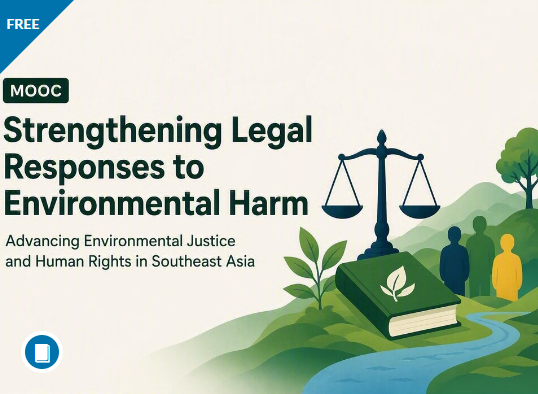
The Raoul Wallenberg Institute offers a self-paced online course, Strengthening Legal Responses to Environmental Harm: Advancing Environmental Justice and Human Rights in Southeast Asia, on RWI Open Online Courses. It is designed for legal practitioners, civil society organisations and public interest advocates in Southeast Asia who work on environmental harm and want to make better use of human rights law in that work.
Environmental harm across Southeast Asia is affecting the rights to life, health, food, water, housing, culture and participation, and the burden falls hardest on communities already facing exclusion. Environmental laws exist in many ASEAN Member States, but access to environmental justice remains uneven. The adoption of the ASEAN Declaration on the Right to a Safe, Clean, Healthy and Sustainable Environment (ADER) in October 2025 gives the region a shared reference point. How much it changes in practice will depend on the people who bring these standards into courtrooms, legal advice, complaints and advocacy.
The course grows out of the online phase of RWI’s Blended Learning Course on environmental rights, held in August and September 2025. The modules were developed by RWI, with input from UNEP, and applied with 23 practitioners from Indonesia, Thailand, the Philippines, Malaysia, Cambodia and Viet Nam. They have now been adapted into a self-paced format in collaboration with the Ateneo de Naga University College of Law, with Domnina Rances, Raziele Raneses, Chiara Guidote and John Mark. Moving online means the material is no longer limited to a selected cohort.
The course covers:
- Foundations of International Environmental Law: its sources, historical development, core principles, and the environmental rule of law.
- Climate Change, Human Rights, and Transboundary Harm: climate change as a human rights issue, including climate justice, vulnerable communities, international climate law, and regional environmental harms in Southeast Asia.
- Environmental Rights and Vulnerable Groups: the right to a clean, healthy and sustainable environment, procedural rights, access to justice, remedies, environmental human rights defenders, and the differentiated impacts of environmental harm on women, Indigenous Peoples and children.
- Accountability, Litigation, and Business Responsibility: strategic litigation, NHRI action, the UN Guiding Principles on Business and Human Rights, corporate due diligence, and access to remedy for business-related environmental harm.
Each module includes explanations, readings, examples, reflection prompts, activities and knowledge checks. The course is self-paced, and participants are encouraged to go through it in sequence from Module 1, since later modules build on earlier concepts. Throughout, they are asked to consider how the principles, cases and strategies apply to their own country, community or professional work.
Enroll here: https://rwionline.eu-west.catalog.canvaslms.com/courses/strengthening-legal-response-seasia
This course was developed under the RWI Regional Asia Pacific Programme Phase II (RAPP II) with the support of the Swedish International Development Cooperation Agency (Sida).