
By Arsen Markiv, Research Associate for Ukraine Team
The SITE 2025 Development Day “Steady against the wind: Ukraine’s and Moldova’s path towards EU membership” in which Zuzana Zalanova and I recently participated, served as a necessary reminder that European integration is a comprehensive, long-term project of institutional transformation. While international attention remains rightly fixed on military aid and macro-economic stability, the true foundation of Ukraine’s path to the European Union lies in successful implementation of the Fundamentals Cluster, in particular, Chapters 23 (Judiciary and Fundamental Rights) and 24 (Justice, Freedom, Security).
The revised EU enlargement methodology of 2020 in connection to the enlargement to the Western Balkans dictates that this Cluster must be opened first and closed last, setting the ultimate pace for all 35 negotiation chapters. Our research perspective confirms this institutional reality: progress on rule of law and fundamental rights is not merely a box to tick, but the non-negotiable enabling condition for every other area of the Acquis.
The Interconnected Power of the Fundamentals
A functioning judiciary and effective anti-corruption infrastructure are prerequisites for integration into the common market. This principle is not abstract, it is intensely practical, linking, for example, the efficiency of a court in Kyiv to the feasibility of a German investment in Odesa.
For instance, the negotiation clusters dealing with the Internal Market would require guarantees on property rights, intellectual property protection, and competition. Without a truly independent judicial system where judges, who can enforce contracts fairly and protect fundamental rights, the economic chapters cannot credibly be closed. We see this linkage clearly in the experiences of past accession countries. The Polish experience, according to Michal Myck, Director at CenEA, Szczecin, from the late 1990s and early 2000s showed that delays in civil justice procedures harm businesses and slowed down the convergence of governance with high-income EU member states[1].
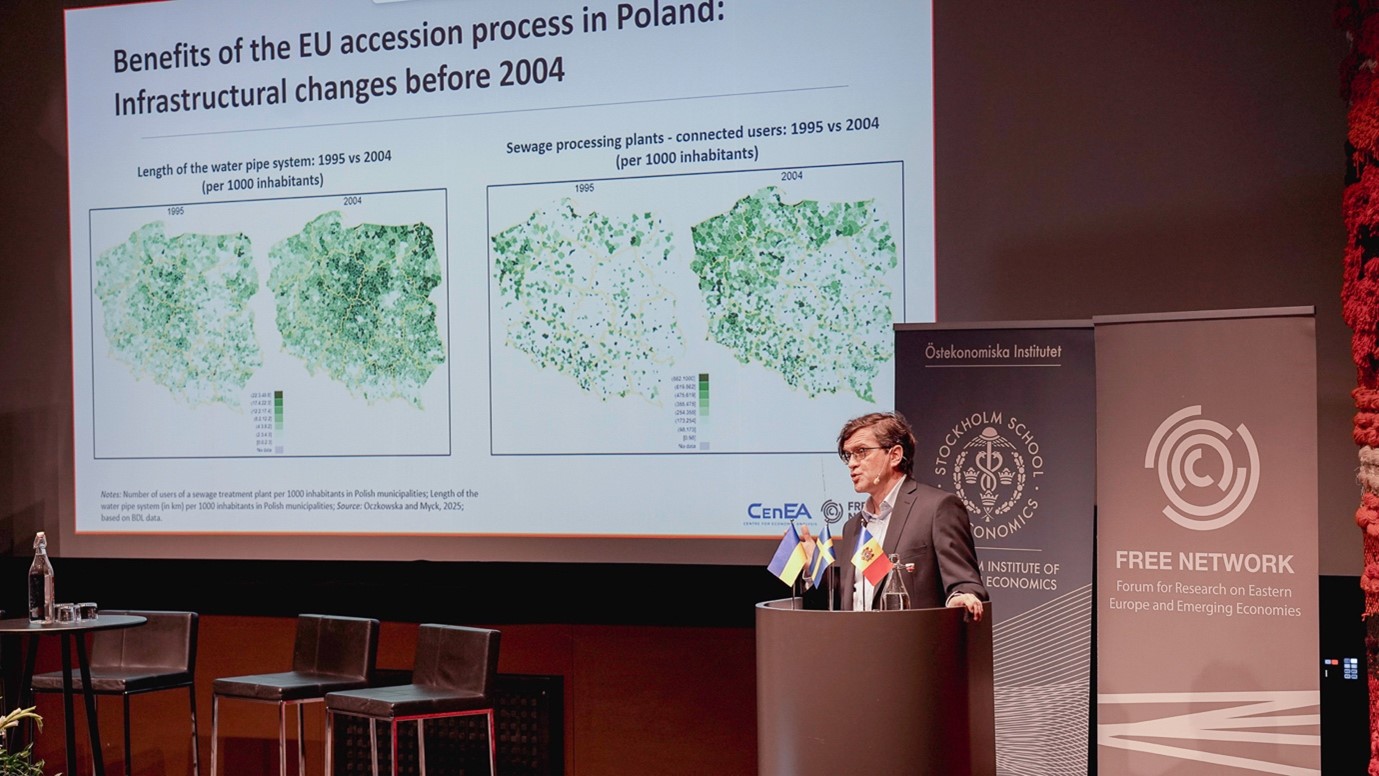
Michal Myck. Photo by Dominick Nilsson
The commitment to the rule of law acts as a national guarantee against institutional instability. It ensures that capital flowing into Ukraine for recovery, whether through state aid or private investment is protected by a clear legal environment. It must be stressed that this connection is not coincidental: the rule of law is closely associated with income level. Societies that guarantee predictability, property rights, and accountability are universally better equipped to generate sustainable economic growth and close the income gap between older member states.[2]
About Our Work: Strengthening Human Rights Infrastructure in Ukraine
Our current program, Human Rights Infrastructure for Ukraine 2025–2027, supports the crucial work required under the Chapter 23 of the Fundamentals Cluster. We collaborate with both central institutions, local authorities and other actors to bolster the rule of law, strengthen human rights protection, and build local capacity for effective human rights protection and service delivery in alignment with the Acquis Communautaire.
The Critical Local Aspect
If the Fundamentals Cluster is the motor of accession, then local self-government is the engine block. The success of many reforms hinges on implementation at the regional and municipal level, far from the central government ministries.
As Klara Lindström, Analyst at the Stockholm Centre for Eastern European Studies highlighted, this operational challenge is considerable: “70% of the Acquis are implemented at local levels. So, if we don’t include localities from the start in the process, the implementation of reforms will become very difficult.”

Viorel Ursu, Klara Lindström and Nataliia Shapoval. Photo by Dominick Nilsson
For Ukraine, the local communities are uniquely critical. They function as the primary point for human rights infrastructure and service delivery, especially in areas hosting millions of internally displaced persons or recovering from occupation. The rule of law in the context of Chapter 23 must be equally accessible and fair in regions of Lviv, Chernihiv and Dnipro, not just in Kyiv. The strength of this local governance structure has already proved vital to national security.
To ensure this local compliance, international support must be channelled to get local leaders on board and to establish a consistent local presence, thereby ensuring that reforms are understood and implemented across all territories, including those close to the frontline and in rural areas.
Tobias Thyberg, Deputy Director General of the Ministry for Foreign Affairs offered a powerful observation: “If it had not been for empowered and strong municipalities all over in Ukraine, there’s no way that Ukraine would have managed those crucial initial months of the full-scale invasion with the tremendous success that it did.” This local capacity constitutes the real-world human rights infrastructure that must be supported.
To support local capacity, RWI is conducting a pilot mapping research study. This project investigates key local institutions in Chernihiv for the advancement of Chapter 23: Judicial Reform and Fundamental Rights, in Ukraine’s EU accession process. The assessment will cover issues such as staffing, management structure, mandate, and division of labour, training provided, including needs assessment, volume of activities, types and trends of complaints/cases, and coordination mechanisms with other actors. By collecting and analysing data from regional structures, we aim to work on actionable, evidence-based recommendations to both the Ukrainian government and international partners on how to ensure that the EU accession process leads to tangible, effective improvements in justice and democratic resilience for all citizens on all levels.
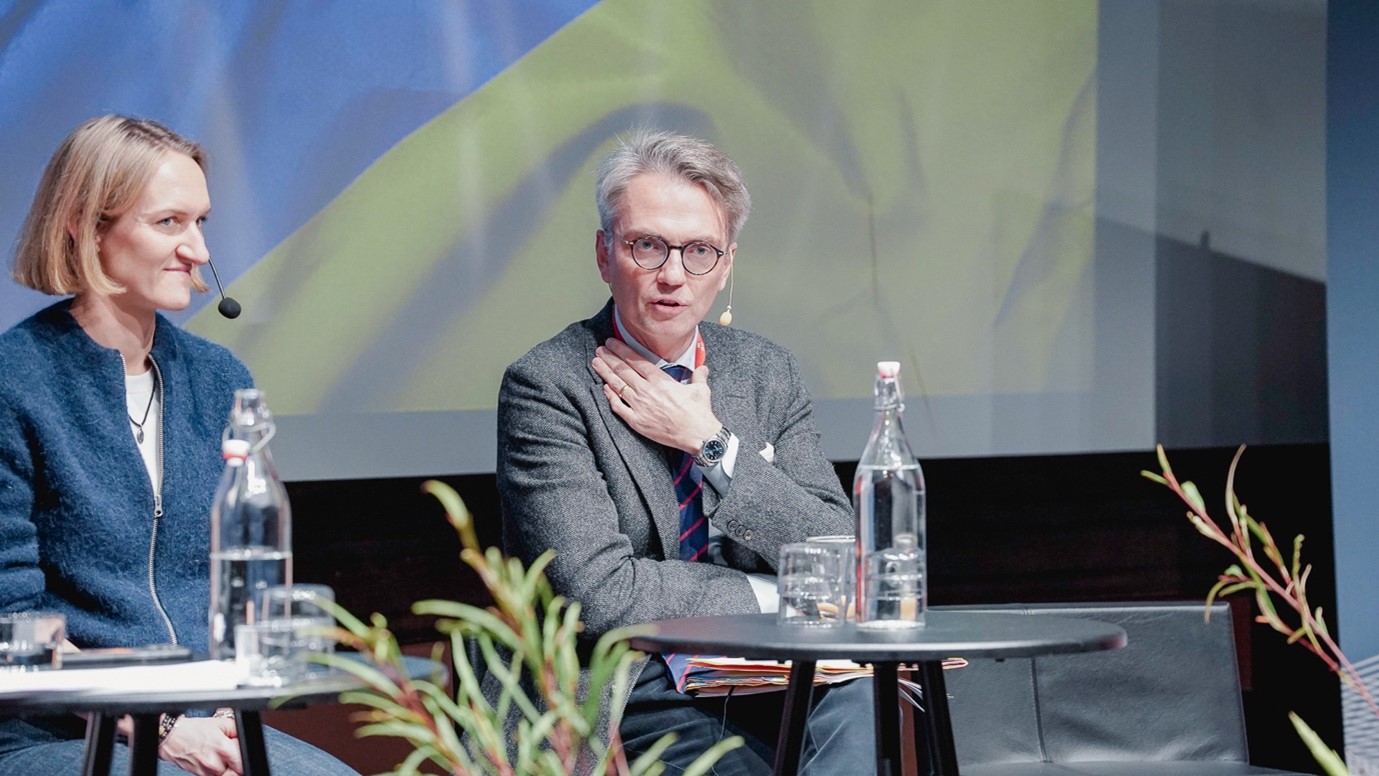
Tobias Thyberg. Photo by Dominick Nilsson
The Test of Institutional Integrity
While one may name corruption as one of the biggest challenges of Ukraine’s future in the EU, the ongoing anti-corruption struggle in Ukraine demonstrates a fundamental characteristic of democratic resilience, the ability to self-correct. While corruption scandals draw negative attention, the underlying story is one of institutional integrity. The fact that the National Anti-Corruption Bureau and the Specialized Anti-Corruption Prosecutor’s Office can independently investigate high-level officials and initiate legal proceedings is proof that the mechanisms established after 2014 are functional.
As stated by a Ukrainian panellist, Nataliia Shapoval, Chairman of KSE Institute, this marks a profound contrast from authoritarian systems: “This situation proved that Ukraine is really still a democracy, that anti-corruption agencies are working, it’s evolving as a positive situation and lesson.” Ukraine is running a real-time test for its democracy, where judicial and anti-corruption measures must be constantly defended against political interference.
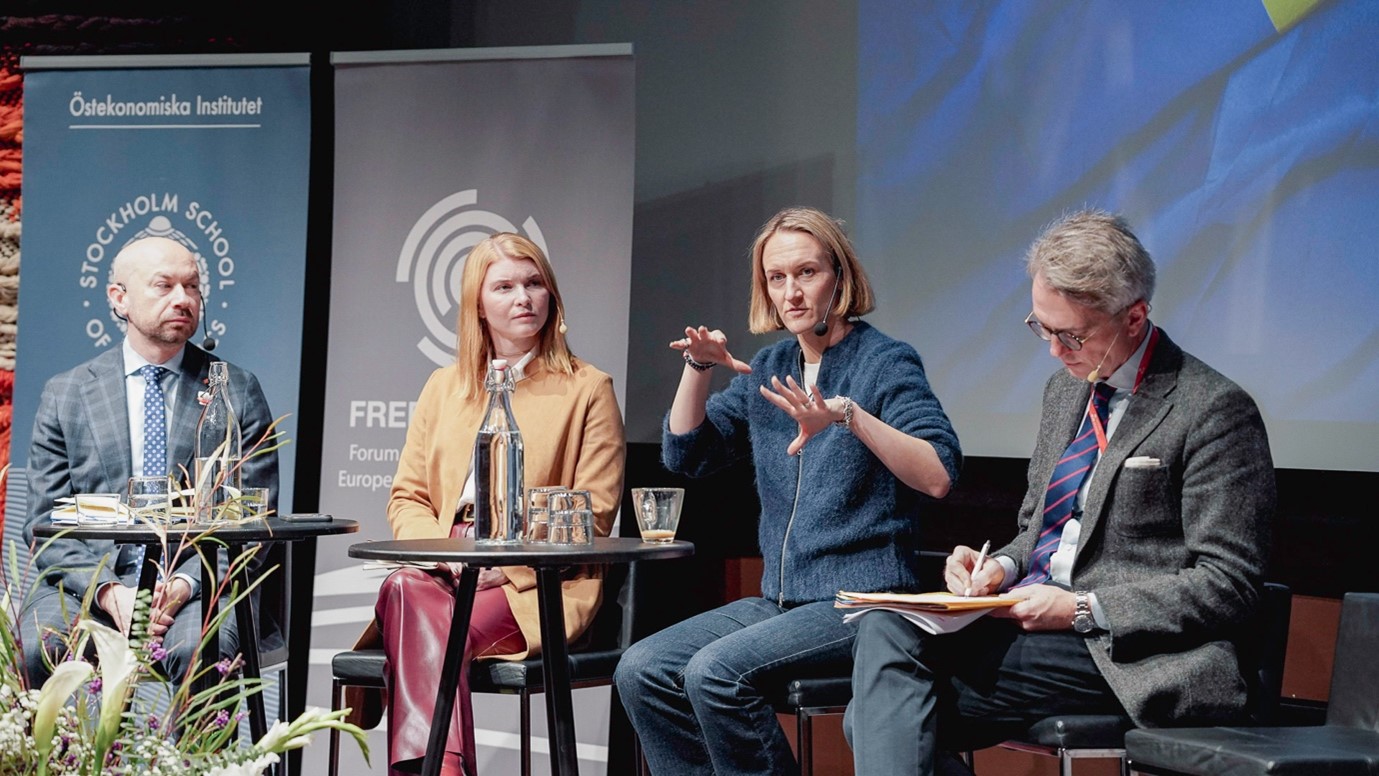
Viorel Ursu, Klara Lindström, Nataliia Shapoval and Tobias Thyberg. Photo by Dominick Nilsson
Moreover, the Polish example from recent political crises highlights that the rule of law is key to inclusive political institutions, it depends on how those laws are respected and enforced.[3] The political process must ensure fair play; popular support for the European path, combined with institutional checks, forms the only reliable guarantee against backsliding.
Conclusion: Partnership for Sustainable Justice
To succeed, international partnership must follow the logic of the Fundamentals Cluster and the local governance reform. More support should pivot towards local level, regional justice centres, and local media to embed justice where it is most needed.
We must also recognize that the journey is non-linear and requires patience. While the correlation between good governance and income is clear, Poland’s experience shows that its “governance indicators saw a general pickup only after EU accession.[4]” This highlights the need for sustained comprehensive international support that extends well beyond the point of formal membership and central level.
By ensuring that reforms are implemented efficiently and fairly at the local level, Ukraine can guarantee the protection of human rights for all citizens and unlock the credible conditions necessary to negotiate every subsequent chapter. Securing justice and human rights infrastructure at the local level is the key to securing Ukraine’s place in the European Union.
Photos by Dominick Nilsson via SITE webpage
[1] World Bank Group. 2017. Lessons from Poland, Insights for Poland: A Sustainable and Inclusive Transition to High Income Status. World Bank, 51
[2] World Bank Group. 2017. Lessons from Poland, Insights for Poland: A Sustainable and Inclusive Transition to High Income Status. World Bank, 50
[3] World Bank Group. 2017. Lessons from Poland, Insights for Poland: A Sustainable and Inclusive Transition to High Income Status. World Bank, 51
[4] World Bank Group. 2017. Lessons from Poland, Insights for Poland: A Sustainable and Inclusive Transition to High Income Status. World Bank, 49