
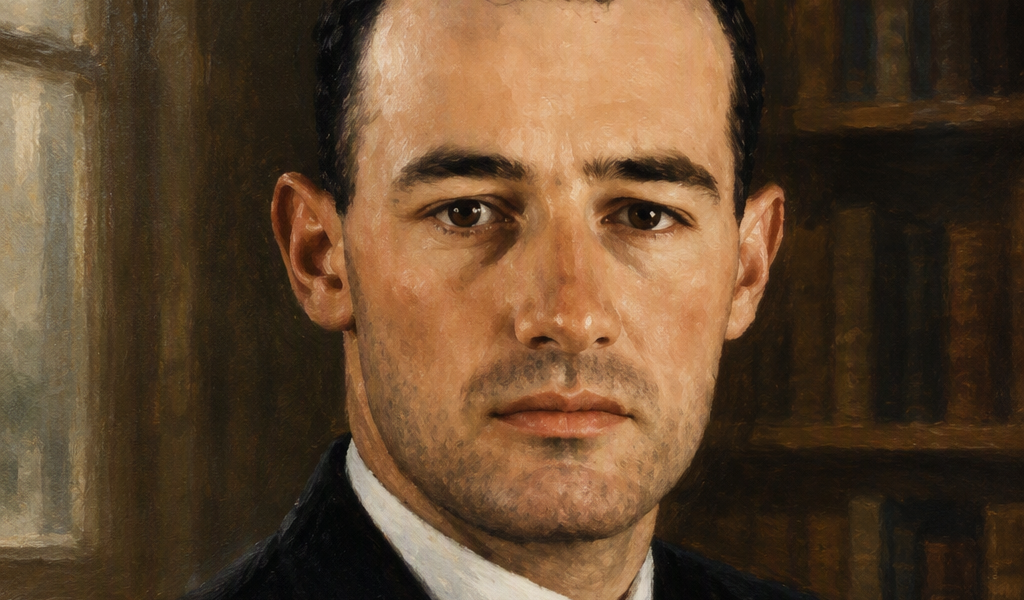
August 4, Raoul Wallenberg’s Birthday
By: Peter Lundberg, Executive Director
Had Raoul Wallenberg been alive today, he would have turned 114 years old. He was not the obvious hero. He was not the most experienced diplomat, the most influential political leader, or the person history had seemingly chosen to change the lives of so many. He was a young man who saw an injustice and decided to act.
That may be the most important lesson of his life.
When many hesitated, he acted. When others saw risks, he saw people. When circumstances made it easy to remain passive, he chose responsibility. Through courage, creativity, and an unwavering belief in human dignity, he helped save tens of thousands of Jews. He was not only a diplomat, but also a humanitarian aid worker in the deepest sense of the term. It was as a humanitarian aid worker that he carried out his work in Budapest. It was as a humanitarian aid worker that he was detained by Soviet forces in January 1945. And it was as a humanitarian aid worker that he disappeared.
We live in a different era today. The specific challenges are not the same. Yet, in many ways, the underlying tests are remarkably similar.
Our world is witnessing the highest number of armed conflicts since the end of the Second World War. At the same time, we see persecution, polarization, antisemitism, Islamophobia, racism, authoritarian tendencies, and people forced to flee for their lives. Humanitarian aid workers and journalists operate under increasingly difficult conditions and all too often pay the ultimate price for their work. Today, as in Wallenberg’s time, we are confronted with the question of how we respond when human dignity is threatened, not only as institutions and states, but also as individuals.
Raoul Wallenberg’s legacy is therefore not primarily about history. It is about responsibility. He reminds us that human rights can never be taken for granted and that they are ultimately defended by people who choose to act when it would be easier to look away.
Many of the institutions and legal frameworks that today form the foundation for the protection of human rights, humanitarian action, and international law were developments that Raoul Wallenberg himself never lived to see. It was the generation of our grandmothers and grandfathers, shaped by war, loss, and reconstruction, that sought to learn from history’s darkest chapters. Out of the ruins emerged international conventions, legal norms, and institutions intended to ensure that the words “Never Again” would become more than a hope.
Yet history also teaches us that progress is never guaranteed.
Since then, the world has once again witnessed genocide, war crimes, and armed conflict. At the same time, the norms and institutions established in the aftermath of the Second World War are facing growing pressure. What previous generations painstakingly built risks being weakened if we are not willing to defend it.
On Raoul Wallenberg’s birthday, it is therefore worth asking a simple but important question:
What does moral courage require of us today?
At the Raoul Wallenberg Institute, we seek to honor Raoul Wallenberg and his legacy by working in his spirit, often with the pen as our most important tool.
We are convinced that knowledge, research, and education are among the strongest defenses of the values that previous generations sought to build in the aftermath of war. In a time marked by disinformation and information warfare, facts, evidence, and independent research are more important than ever.
Through research, education, and international cooperation, we strive to help educate the next generation of lawyers, decision-makers, and engaged citizens who can carry these principles forward. We are also developing new tools to collect and analyze data related to incidents connected to international humanitarian law. This, too, is a way of using the pen as a weapon for accountability, transparency, and justice.
But much more remains to be done. Time is short, and the forces working in the opposite direction are strong. That was never a reason for Raoul Wallenberg to step back. Nor should it be for us.
If the generation of our grandmothers and grandfathers could learn from the devastation of war and build institutions for peace, justice, and human dignity, then the question is what our generation will do with the legacy we have inherited.
August 4 is therefore not only a day to remember Raoul Wallenberg. It is a day to ask ourselves what responsibility we are prepared to take in defending the principles that emerged from history’s most painful lessons. Safeguarding the rules-based international order is not only the responsibility of states, courts, or international organizations. It is also the responsibility of each of us. Because, in the end, it is people who build institutions, and people who decide whether they endure, weaken or fail.