
By: Charlie Meidino Albajili, Programme Officer for Access to Justice/Business and Human Rights, Jakarta Office
The Raoul Wallenberg Institute’s Regional Asia Pacific Programme has published a new discussion brief on the role of National Human Rights Institutions (NHRIs) in bringing the ASEAN Declaration on the Right to a Safe, Clean, Healthy and Sustainable Environment (ADER) to life – at a moment when the Declaration’s forthcoming Regional Plan of Action (RPA) is still being shaped.
Developed from the deliberations of NHRI officials across Southeast Asia, the brief offers a set of options and entry points to inform their engagement with the RPA process, while leaving the choices of role and priority to each institution.
Why this brief, and why now
Adopted as a soft-law instrument, the ADER’s effectiveness will depend on how it is operationalised at the national and regional levels. The development of its Regional Plan of Action offers a timely opening to clarify institutional roles, coordination mechanisms, and implementation pathways.
The brief reflects a view expressed by participating NHRIs themselves: that their mandates to monitor, investigate, advise governments, and engage affected communities place them in a strong position to contribute on-the-ground evidence and monitoring capacity — particularly where judicial and enforcement pathways for environmental harm remain weak or inaccessible.
A contribution rooted in NHRI mandates
Rather than prescribing a fixed role, the brief explores how NHRIs might draw on the full range of their functions to support the ADER’s implementation. It organises this around three themes that emerged from the course: strengthening the ADER as a substantive regional reference over time; drawing on the whole of an NHRI’s mandate through an integrated, institution-wide approach; and using Multilateral Environmental Agreements to give environmental rights claims a firmer scientific and legal footing.
It also looks ahead to areas where the ongoing RPA consultation offers scope to strengthen implementation — including clearer recognition of environmental human rights defenders and Indigenous Peoples, and fuller attention to corporate accountability and human rights due diligence — and acknowledges the real constraints NHRIs face on transboundary harm that no single institution can address alone.
A practical desk tool, not a statement of intent
A distinguishing feature of the brief is its Companion Action Tracker: a framework, developed with participating NHRIs, that translates broad themes into practical action items across the core functions of an NHRI — promotion, protection, policy, measurement, partnership, and regional engagement. It is designed to be adapted to each institution’s own mandate, context, and planning cycle, inviting NHRIs to attach a focal point, a target date, and a verifiable output to the actions they choose to take forward.
For transboundary challenges — haze, plastic pollution, the degradation of shared river systems — the brief points to the Southeast Asia NHRI Forum (SEANF), the NHRIs’ own regional platform, as a channel through which member institutions may choose to act collectively and engage AICHR with a shared voice.
Grounded in regional practice
The brief draws on the discussions and outputs of the 2026 Southeast Asia NHRI Course on Environmental Rights, a blended learning programme delivered online from May to June 2026 and concluding with a two-day in-person workshop in Bangkok on 9–10 June 2026. The course brought together officials from five NHRIs across the region — the Commission on Human Rights of the Philippines (CHR), The National Commission on Human Rights of Indonesia (Komnas HAM), the National Human Rights Commission of Thailand (NHRCT), the Provedoria dos Direitos Humanos e Justiça (PDHJ, Timor-Leste), and the Human Rights Commission of Malaysia (SUHAKAM) — to exchange practice and translate regional frameworks into approaches suited to their own institutions.
The programme was designed and facilitated by Karen Gomez Dumpit and team as RWI’s engaged consultant, with contributions from the United Nations Environment Programme (UNEP), the United Nations Economic and Social Commission for Asia and the Pacific (UNESCAP), and AICHR Thailand. The deliberations and comments of participating NHRI officials shaped the brief directly.
Read the brief
The discussion brief, Advancing the ASEAN Environmental Rights Declaration: A Strategic Agenda for NHRIs, is available to read and download here
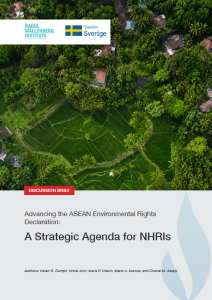 It is authored by Karen Gomez Dumpit, Windi Arini, Maria P. Villarin, Maria Lycah A. Mancia, and Charlie M. Albajili.
This publication was produced under the RWI Regional Asia Pacific Programme Phase II (RAPP II) with the support of the Swedish International Development Cooperation Agency (Sida). The views expressed are those of the authors and do not necessarily reflect the views or positions of RWI, Sida, or the participating institutions.