
By Halyna Kokhan, Programme Officer
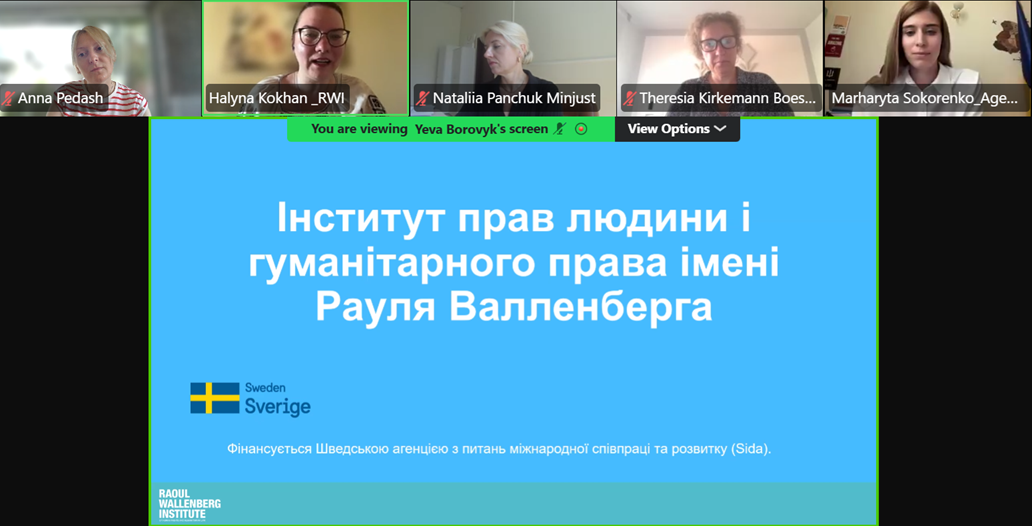
The Raoul Wallenberg Institute of Human Rights and Humanitarian Law (RWI) and Ukraine’s Ministry of Justice co-hosted an online event on 29 June 2026 to present a new comparative study on the execution of European Court of Human Rights (ECtHR) judgments in systemic and structural cases. The event was held within RWI’s Human Rights Infrastructure for Ukraine (HRIU) Programme (2025–2027), funded by the Swedish International Development Cooperation Agency (Sida).
The study “Execution of ECtHR Judgments in Systemic and Structural Cases: Institutional Practice, Reform Processes and Monitoring Frameworks – Comparative Lessons for Ukraine” was authored by RWI consultants Arlind Puka and Daniel Goinic. The event opened with welcome remarks from Nataliia Panchuk, Head of the Directorate for Strategic Planning and European Integration at the Ministry of Justice, Margarita Sokorenko, Government Agent before the ECtHR, and Theresia Kirkemann Boesen, Ukraine Country Director.

The event drew broad participation from across Ukraine’s justice sector — around 60 officials joined, representing the Ministry of Justice, the High Council of Justice, the Apparatus of the Supreme Court, the Prosecutor Training Center and the Office of the Prosecutor General, the Ministry of Internal Affairs, the State Border Guard Service, and the State Criminal-Executive Service.
In her opening remarks, Theresia Kirkemann Boesen underlined why the study matters now. Execution of ECtHR judgments, she said, is not a bureaucratic formality but a practical test of whether human rights commitments deliver real change for the people who bring cases to Strasbourg and for the wider population that depends on functioning institutions. With a substantial caseload before the Court, many of Ukraine’s judgments reflect systemic issues in judicial practice, prosecutorial effectiveness, enforcement of domestic judgments and institutional independence — problems that call for structural, not case-by-case, responses. She also linked the study directly to Ukraine’s EU accession path, noting that the capacity to execute ECtHR judgments effectively feeds into the rule-of-law benchmarks at the heart of that process.
A practice-oriented comparative lens
Rather than surveying ECtHR case law in the abstract, the study examines how eight Council of Europe member states (Romania, Poland, Italy, Slovenia, Croatia, Bulgaria, Germany and Moldova) have turned execution into a governance, reform and accountability process. Countries were selected for their experience with systemic and structural violations, pilot judgments and enhanced supervision, and for the relevance of their solutions to Ukraine’s own reform agenda.
The presentation walked through five areas of comparative practice:
- Coordination mechanisms.Successful execution systems consistently rely on a clearly designated coordinating authority backed by structured cooperation between government, courts, prosecutors and parliament — models ranging from the Czech “Kolegium” to Poland’s Inter-Ministerial Committee and Moldova’s Government Agent with parliamentary oversight.
- Domestic remedies as the first line of defence.Comparative experience from Italy’s Pinto remedy, Slovenia’s Lukenda reforms, Croatia’s dual acceleratory-compensatory model and Germany’s delay-objection mechanism shows that combining preventive and compensatory remedies, alongside case-management and digitalisation, is the most effective way to reduce repetitive Article 6 violations, including the non-enforcement of domestic judgments — an area where Ukraine has been found by the Court to face widespread, structural gaps.
- Judicial independence as an execution issue.Where violations stem from appointment defects, disciplinary pressure or irregular court composition, execution touches the institutional design of the judiciary itself. The study set out safeguards — precisely defined disciplinary offences, transparent and reviewable rules on appointments and case allocation, and clear boundaries between legitimate reform and interference in pending cases — drawing on the differing experiences of Romania, Croatia, Slovenia and Poland.
- Effective investigations under Articles 2 and 3 of the ECHR.Presenters set out the Court’s criteria for what makes an investigation effective — independence, thoroughness, promptness, victim participation and accountability — and how specialised investigative structures and judicial oversight can address recurring violations.
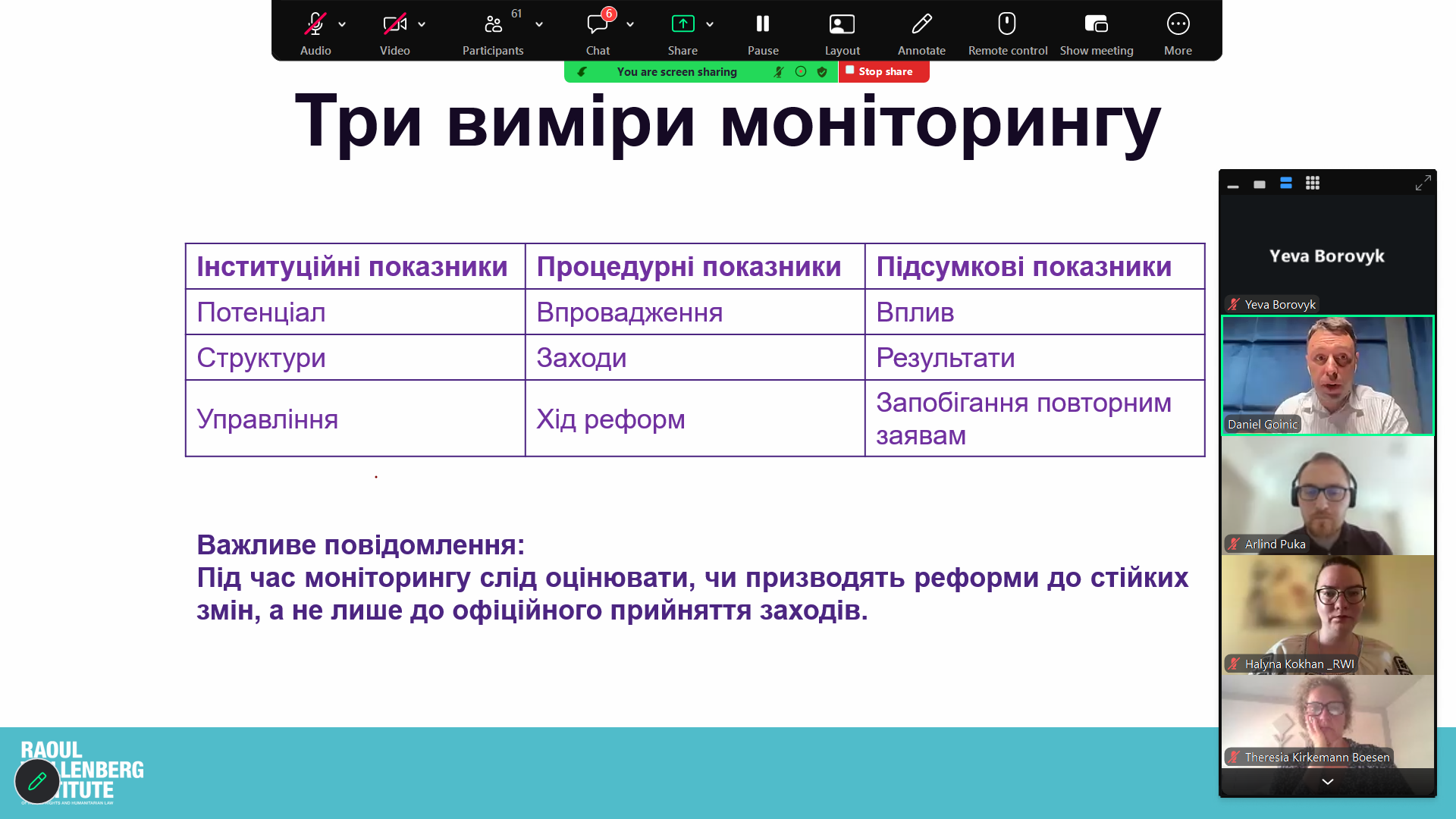
- From compliance to effectiveness in monitoring.The study proposed a shift from asking how many judgments or action plans have been closed, to asking whether the underlying structural problem has actually been resolved — tracking institutional, procedural and outcome indicators rather than closure counts alone.
Where Ukraine stands
Presenters noted that Ukraine closed 97 cases in 2025, including 11 leading cases, and made progress on important structural issues such as judicial independence and life-sentence review, even amid the ongoing armed conflict. At the same time, 904 cases remain pending execution and 55 leading cases remain under enhanced supervision, with several structural cases pending for more than five years — underscoring the need for more systematic monitoring and prioritisation.
Building on this analysis, the study set out possible legislative directions for Ukraine, including developing a new draft law on the execution of EctHR judgments; introducing annual, performance-based monitoring; organising execution around structural problems identified in leading and pilot judgments; strengthening the coordinating and analytical mandate of the Government Agent; establishing parliamentary review of systemic execution challenges; and clarifying rules on reopening proceedings following ECtHR judgments, alongside further development of preventive and compensatory domestic remedies.
RWI thanked the Ministry of Justice, and in particular Margarita Sokorenko and Nataliia Panchuk and their teams, for the trust to commission the study and co-hosting of the event. Within the HRIU programme, RWI will continue to work with the Ministry of Justice and other partners to translate the study’s recommendations into concrete technical assistance, as part of its long-term support to Ukraine’s human rights infrastructure.
Learn more about our work in Ukraine: https://rwi.lu.se/ukraine/