

RWI recently sent a delegation, led by its Director Morten Kjaerum, to Brussels to attend the flagship event of the European Year for Development 2015, the European Development Days and its joint event on the role that National Human Rights Institutions play in the development agenda.
This yearly event enables organisers and participants to share their experiences, raise awareness, engage the press and encourage a dialogue around the topic of international cooperation and development.
Parallel to the main agenda, the European Commission organised a joint event with the International Coordinating Committee for National Human Rights Institutions (ICC) and its four regional networks. This event aimed at addressing the role, potential and challenges of NHRIs in development, in particular in the context of discussions for the post-2015 agenda for development and the future sustainable development goals (SDGs).
Themes included the role of NHRIs in the post-2015 development framework, their interactions with public institutions and CSOs, as well as their work on business and human rights, and economic, social and cultural rights. Crucial to this event were also the various avenues for EU support and interactions with NHRIs, at a time when the European Union is enhancing its support towards NHRIs.
All the NHRIs of the EU Member States were invited. Ninety-two representatives of either NHRIs, ICC or from Regional Networks expressed their wishes to participate. It is in this context that the RWI, and more specifically the Institute’s NHRI Unit, was particularly engaged, with RWI Director Morten Kjaerum invited to join two different working panels: NHRIs and Policy-Making and Public Institutions and NANHRI’s Strategic Plan (2015-2019) Launch.
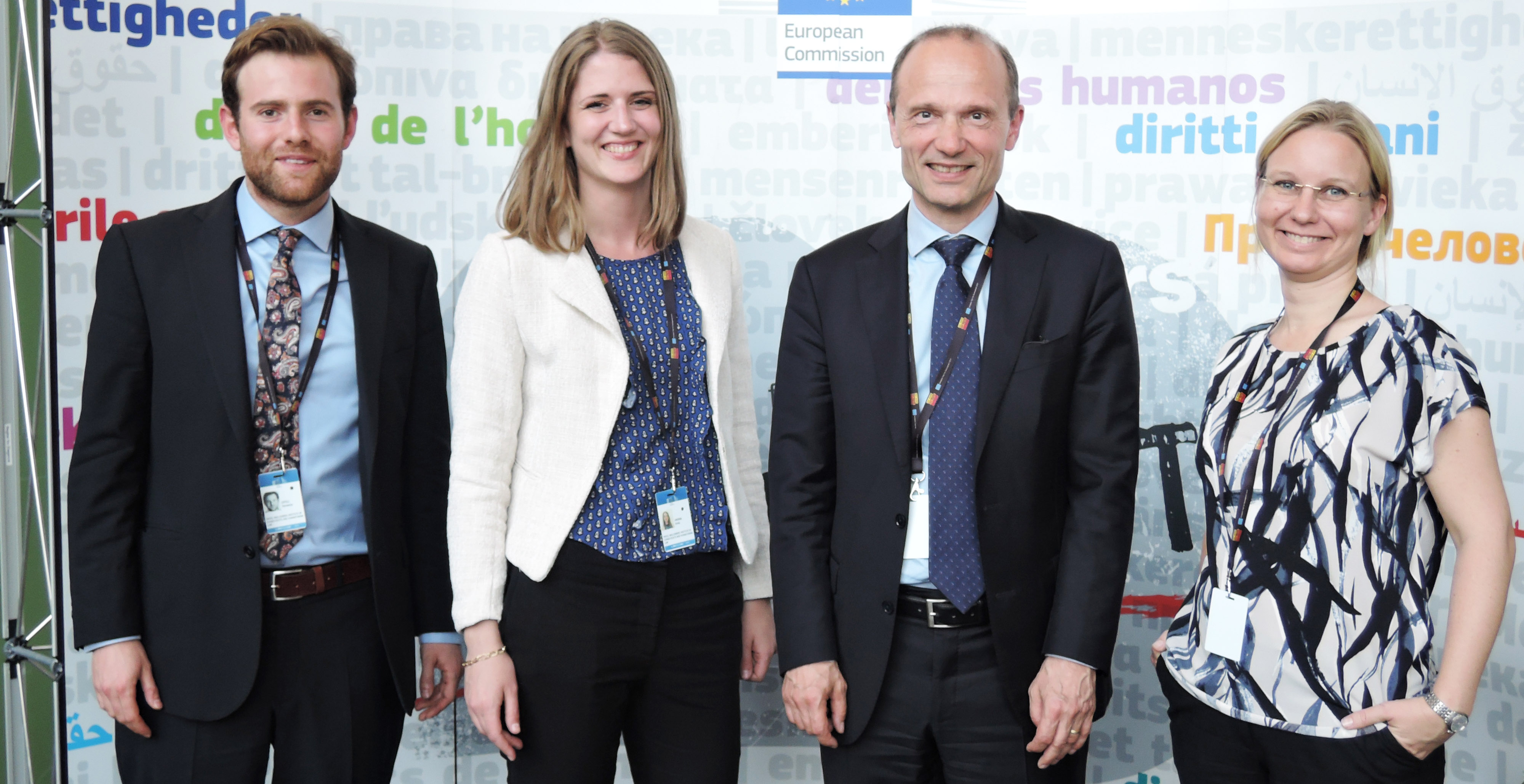
We asked a few questions to Emily Hanna, Madelene Eichhorn and Domenico Zipoli from RWI’s NHRI Unit to get a better sense of what’s happening in the field.
What was the most interesting/exciting thing that happened during the conference?
“Attendance to events such as this are a great opportunity for us to feel the pulse of the ongoing developments within the area of NHRIs as well as a representing a meeting venue with all our relevant direct and indirect stakeholders. This specific conference was especially useful due to the very high number of NHRI representatives attending from all over the world, as well as for its thematic focus on development issues and avenues for EU support and interactions.
“The fact that international actors, such as the European Union, are paying more attention to the important role which NHRIs can play, and are willing to support them to a much larger extent than has previously been the case. Paris Principles compliant NHRIs are becoming important and credible actors for the promotion and protection of human rights on the national level, given their unique status as independent national institutions. It is very encouraging to see that this unique role is increasingly being recognized internationally.”
What are the new trends within the NHRI field?
Amongst the various enlightening discussions that took place during the two-day event, we would like to highlight a number of key developments raised.
• “The need for an increased use of research-drawn data for evidence based policy influence. This point was often raised during different panel discussions, with the importance of solid, validated evidence for influencing national policy highlighted as a powerful tool for NHRIs to use worldwide. Two different yet complimentary means for NHRIs to accomplish this is through the set-up of national inquiries and the gathering of evidence using large-scale surveys.
• “Sustainable Development Goals (SDGs) and the role of NHRIs . How human rights can be realised through the SDGs was also something that came out strongly as opportunities for NHRIs to promote and protect human rights in a streamlined fashion within the global, regional and national settings.
• “The role of NHRIs in conflict environments. It was evident from many participants’ comments that the past years’ changing political environments for many NHRIs has forced them to operate under very difficult circumstances (threats etc). As such there is a need for joint efforts and support by neighboring NHRIs and networks to show solidarity with the NHRIs who are experiencing difficult working conditions. NHRIs also pointed to how they should work in relation to the large migration flows that have resulted from these conflicts.
• “Extraterritorial obligations and NHRIs in the business context. Within an ever more decentralized system of domestic human rights protection, NHRIs are not only strengthening their role as independent advisory and complaints handling bodies vis-à-vis their own state authorities. NHRIs have in fact expanded their scope of action to the private sector, and in this context have started to deal with cases of human rights violations by the hands of corporations. The most innovative (and challenging) aspect of this new trend is that a number of NHRIs have recently been initiating investigations into alleged violations of human rights by foreign corporations. It is through this novel approach that the dangerous gap of foreign accountability is finally being tackled.
• “The reference to the human rights based approach/victim centered approach was raised during several of the sessions as the basis from which NHRIS should carry out their work. It is important to listen to those who are affected by human rights violations in order for the NHRI to advocate for national policies, practices and legislation that include the people who will be affected by them in the process.”