
By Peacewell Makhurane, Junior programme Officier
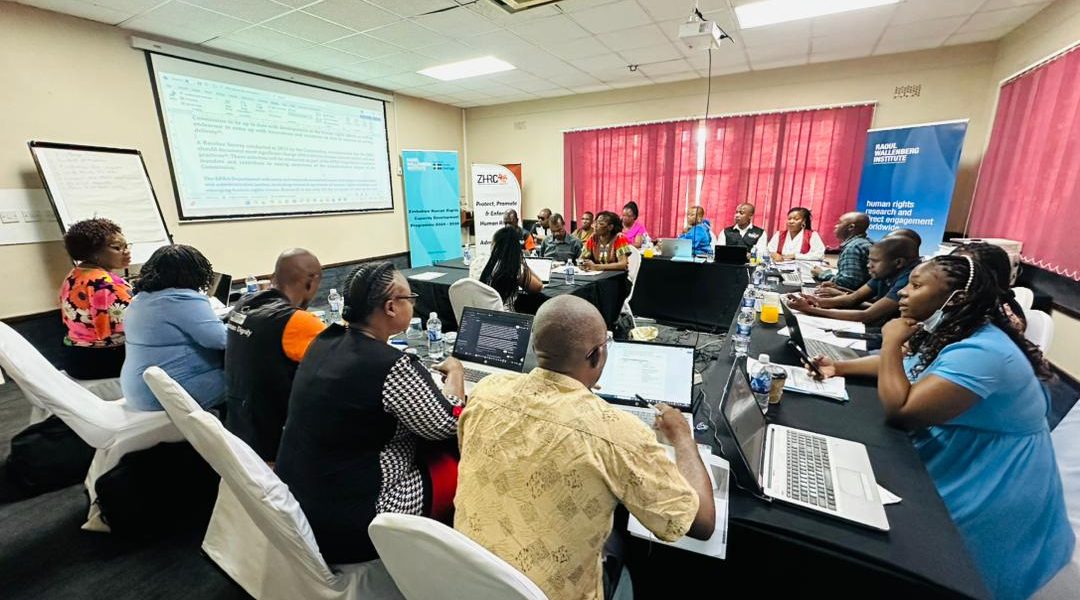
The RWI Harare office in collaboration with the Zimbabwe Human Rights Commission (ZHRC), recently held a four-day workshop to review and finalise the commission’s Education, Promotion, Research and Advocacy (EPRA) Manual. With 20 participants across ZHRC offices, the workshop provided space for a thorough and collaborative review of the manual.
The review of the EPRA Manual comes at an important time for the Commission following the expansion of the mandate of the Education, Promotion and Research Department to include knowledge management and advocacy. Over the past two years, RWI supported the review of a draft manual by engaging a regional National Human Rights Institution (NHRI) expert who provided technical input on knowledge management, research, and advocacy. In addition, RWI organised a capacity development workshop for the ZHRC Secretariat, which strengthened their knowledge and skills in research, advocacy paper development, and knowledge management. Building on this, the Commission undertook revisions of the manual in 2025, creating the need for a final review process in 2026.
The workshop was highly participatory, including plenary discussions, group work, breakout sessions, practical drafting and peer review exercises. This approach promoted active engagement and fostered a strong sense of ownership among participants. The result is an updated EPRA Manual, now submitted to ZHRC management for approval. The manual provides a standardised framework to guide the planning and implementation of the Commission’s work in human rights education, promotion, research, advocacy and knowledge management. It also serves as an induction resource for Commissioners and newly recruited staff.
This workshop is part of the broader RWI-ZHRC collaboration under the RWI Zimbabwe Human Rights Capacity Development Programme (2024–2026), funded by Sweden. A key component of this cooperation is support to the development of institutional reference materials, including training manuals. These tools play an important role, preserving institutional knowledge and ensure sustainability of results. The manuals are also a valuable resource for human rights practitioners in civil society, government institutions, and other stakeholders when conducting human rights training.